
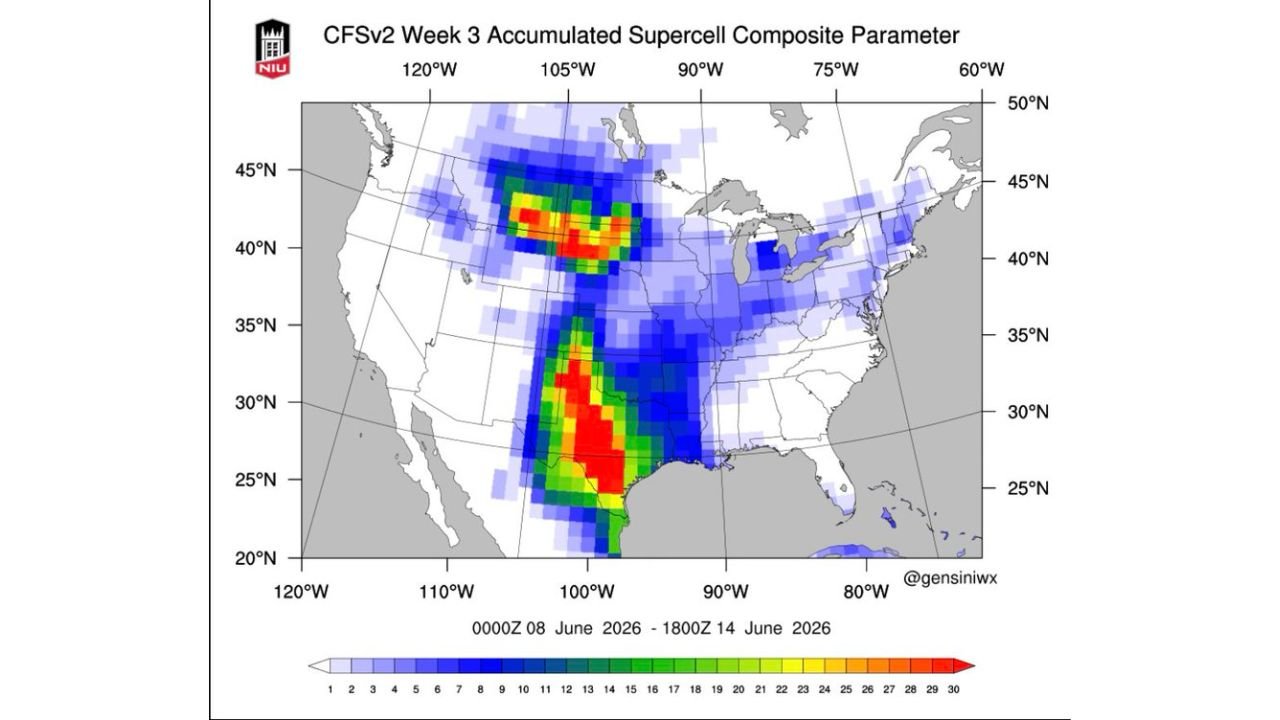
OKLAHOMA CITY, OKLAHOMA — Long-range modeling is turning heads in the storm chasing and severe weather community, with the CFSv2 Week 3 Accumulated Supercell Composite Parameter showing a significant and well-defined signal for supercell thunderstorm potential across the central and southern plains during the June 8 to June 14, 2026 timeframe.
CFSv2 Week 3 Map Shows Intense Red Core Across Texas, Oklahoma and Louisiana
The CFSv2 Week 3 Accumulated Supercell Composite Parameter, valid from 0000Z June 8, 2026 through 1800Z June 14, 2026, is showing its highest values concentrated in a deep red corridor stretching from central Texas southward through the Gulf Coast region and into Louisiana. Values on the color scale are reaching the 25 to 30 range across this core zone, representing the most favorable atmospheric environment for supercell development anywhere on the map during this period.
Oklahoma and Kansas also sit within an elevated zone of supercell composite values, with green and yellow shading pushing into those states and indicating a broad swath of the southern and central plains could see organized and potentially dangerous storm activity during this window.
Secondary Hot Spot Visible Across Nebraska, South Dakota and the Northern Plains
A distinct secondary area of elevated supercell composite values is visible across the northern plains, centered near Nebraska and South Dakota with red and orange cores reaching into that region around the 40N latitude band. This two-pronged signal suggests the active storm pattern could affect both the southern and northern plains simultaneously during the June 8 to 14 window.
Blue shading extends further into the upper Midwest and even touches parts of the Great Lakes region, indicating the broader atmospheric environment favorable for storm development stretches well beyond just the classic tornado alley corridor.
Storm Chasing Community Already Watching This Window Closely
The appearance of this signal has generated significant excitement, with early indications suggesting the plains may be back in an active severe weather pattern heading into mid-June. It is important to note this remains a long-range signal and exact details will become clearer as the timeframe approaches.
Residents across Texas, Oklahoma, Kansas, Nebraska, and Louisiana should begin monitoring forecasts as June 8 approaches.
Stay with GordonRamsayClub.com for the latest updates.

Leave a Reply