
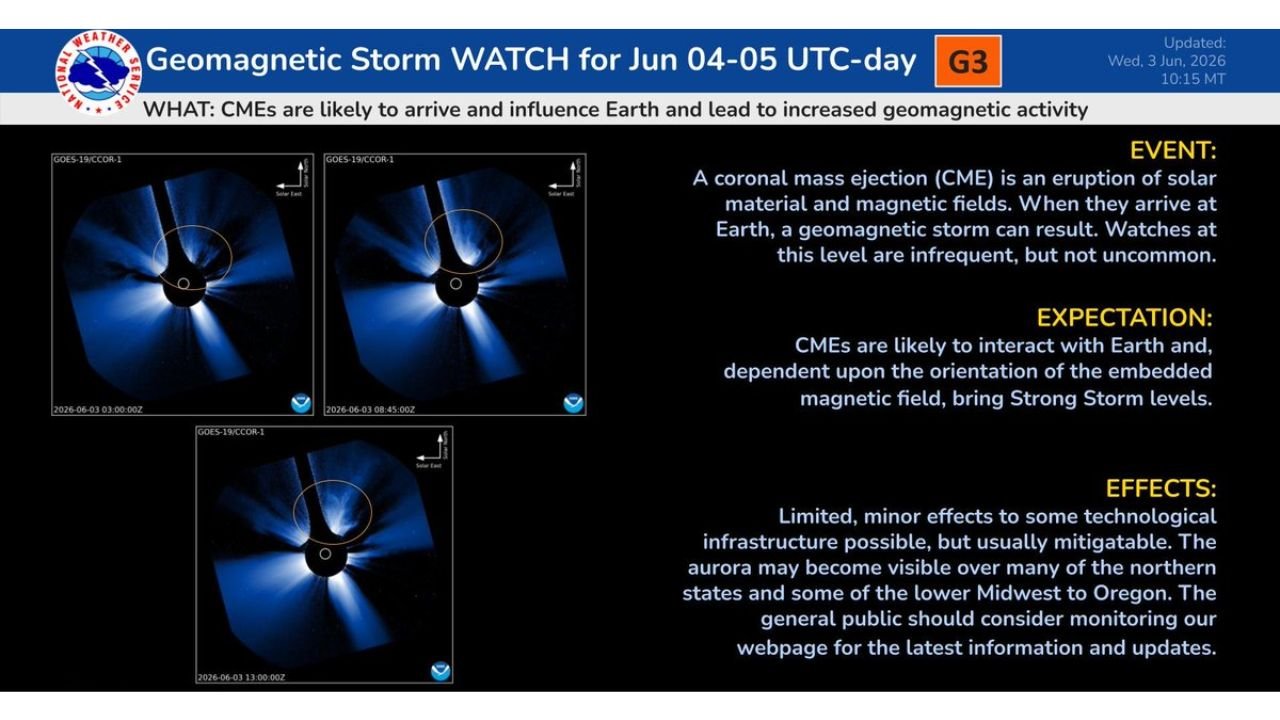
BOULDER, COLORADO — The NOAA Space Weather Prediction Center has issued a G3 Strong Geomagnetic Storm Watch for June 4 to 5 UTC-day 2026, updated June 3, 2026 at 10:15 MT, as coronal mass ejections are likely to arrive and interact with Earth’s magnetic field and drive increased geomagnetic activity across the northern United States and into the lower Midwest and Pacific Northwest.
NOAA Issues G3 Geomagnetic Storm Watch for June 4 to 5 UTC-Day
The National Weather Service Space Weather Prediction Center in Boulder, Colorado has placed a G3 level Geomagnetic Storm Watch in effect for June 4 to 5 UTC-day. GOES-19 and CCOR-1 satellite imagery captured on June 3, 2026 at 3:00 AM, 8:45 AM, and 1:00 PM UTC confirms the coronal mass ejection activity departing the Sun and heading toward Earth. CMEs at this level are considered infrequent but not uncommon, and NOAA notes that watches at this intensity level warrant public awareness and monitoring of space weather developments.
Coronal Mass Ejections Likely to Interact with Earth and Bring Strong Storm Levels
CMEs represent eruptions of solar material and magnetic fields from the Sun’s surface. When these eruptions arrive at Earth, they interact with the planet’s magnetosphere and can produce geomagnetic storms of varying intensity. For the June 4 to 5 event, NOAA expects the CMEs to likely interact with Earth and depending on the orientation of the embedded magnetic field within the ejections, could bring Strong Storm level geomagnetic impacts at the G3 classification across the affected regions.
Aurora May Become Visible Across Northern States and Lower Midwest to Oregon
One of the most notable public impacts of a G3 geomagnetic storm is the potential for aurora visibility well south of its typical range. NOAA indicates the aurora may become visible over many of the northern states and some of the lower Midwest through Oregon during the June 4 to 5 event window. Residents across Minnesota, Wisconsin, Michigan, Montana, Idaho, Oregon, and surrounding northern tier states should watch for aurora displays during the overnight hours of June 4 to 5, 2026, particularly in areas with dark skies and clear conditions.
Minor Effects to Technological Infrastructure Possible but Generally Mitigatable
NOAA notes that limited and minor effects to some technological infrastructure are possible during a G3 geomagnetic storm, including potential impacts to power grid fluctuations, satellite operations, and GPS accuracy. However, these effects are described as generally mitigatable and the overall risk to critical infrastructure remains manageable at the G3 level. The general public is encouraged to monitor the NOAA Space Weather Prediction Center webpage for the latest information and updates as the CMEs approach Earth on June 4 to 5.
Stay with GordonRamsayClub.com for the latest updates.

Leave a Reply